Put your health into focus with Advanced Labs
All the collected information may not be part of the user model; here, only the data required and used to provide personalization are described under the user model. In cases where it could not be determined how the measured quantity was used, it has been mentioned as part of the profile descriptions. In the case of recommendations, personalization was seen with respect to goal setting, activity suggestion, and selection of fitness partners. Feedback was found to be personalized with respect to the content, which could be motivational or educational, or with respect to the timing of its delivery.
Injury Prevention And Rehabilitation Apps
Such BCT parameters were inferred using questionnaires such as the 20-item Weight Efficacy-Lifestyle Questionnaire and the 44-item Big Five Inventory Questionnaire that sought answers from users. Studies using BCT parameters had interventions that were knowledge-based, except in the studies by Hermens et al and Hales et al [54,74]. The remaining 18 studies generated activity recommendations based on automated systems. These studies generated the activity or behavior recommendation by considering contextual information such as location [45,56,86] or preferences [32,66,85]. Invest in a fitness tracker or app to monitor progress and receive tailored suggestions.
This target is in terms of an activity evaluation metric, such as duration of activity, step count, or calorie expenditure. Note that if an activity is prescribed without quantification, then we classify it as an activity recommendation and not a goal recommendation. Rest days and recovery-focused activities, such as light yoga or stretching, are essential for optimal performance. If life gets in the way of your weekly plans, you can connect with the AI coach to adjust your plans and get advice. Whether you’re #1 in the world or on day 1 of your journey, WHOOP helps you optimize your health, fitness, and life. Whether you are a gym owner looking to boost retention or a mover looking to get fit, we have the tools for you.
While still in their early stages, VR and AR, with their interactive features and components, are set to revolutionize fitness and health promotion, blending entertainment with movement to help people stay active. We want to emphasize that the interpretation of the results in this study is somewhat subjective, as it relies on the authors’ experience with advanced language models. Although we endeavoured to maintain objectivity, it is important to acknowledge that different reviewers may hold varying interpretations of the findings.
- There were 9 studies with semiautomated interventions, and the combinations of manual and automatic elements in them varied.
- After a knee injury, Mark worked with a trainer to develop a low-impact program focusing on strength and flexibility.
- For instance, AI-powered wearables could alert users about potential health risks, such as heart attacks or strokes, before they happen, allowing for earlier interventions and better management of chronic conditions.
- AI fitness platforms collect and analyze a wealth of information, ranging from demographic details and stated fitness goals to biometric data gleaned from wearable technology and self-reported health conditions.
- Furthermore, the program’s lack of preliminary patient assessment is a notable shortcoming.
- Emily is a 27-year-old individual grappling with anxiety and stress-related issues, and managed with Sertraline, an antidepressant.
A study that personalized messages using reinforcement learning concluded that the difference in users’ exercise on a given day could be learnt by the learning algorithm, thus making user behavior predictable [9]. The methodology of utilizing activities of daily life for profiling users and their behavior [86] is another approach for estimating user behavior. User preferences could also be learnt through greedy approaches [86] or through inherent model design [45]. In both RCT and other studies, several studies have shown significant improvement in the PA of the participants due to personalized interventions. The study by Cook et al [30] showed a significant intervention effect with an increase in active commute and leisure time PA as well as PA in schools for the adolescents. The MyBehavior app evaluation study [45] also stated an increase in walking minutes and calories burnt in nonwalking exercises as compared with the baseline.
Exercise Program Generation and Evaluation
However, a fully featured enterprise-grade application with custom computer vision models typically requires 6 to 9 months of development time. By prioritizing user privacy and clinical accuracy, brands can build high-retention platforms that truly transform user health. At Developers.dev, we provide the specialized engineering PODs and AI expertise needed to turn these complex requirements into a seamless digital reality. In a modern AI fitness app, we utilize “sensor fusion”-the process of combining data from multiple sources to reduce uncertainty. While these tools have value, they lack the ability to adapt instantly to the individual user’s needs during a workout, something AI is beginning to solve. Ongoing feedback from remote monitoring provides care plan accountability and follow-through.
Building a Healthier Future

Messages in this category targeted users specifically to elicit an action by also utilizing techniques including the users’ name or providing users’ current PA status [3]. However, as mentioned in the exclusion criteria, using only statistics or name in a standard template message is not considered personalization. All the above-mentioned studies set a goal for the user before the user activity began. However, in the personalized PA prescription intervention study [81], the goal was not explicitly known by the user before the activity, although a Web interface allowed the user to check the goal recommendation. It also defined a user goal in terms of target HR and duration of activity, which was sent to the activity monitor.

Real-time feedback
Future research should explore the interactive capabilities of AI models, including ChatGPT, to determine if they can be harnessed to enhance the specificity and effectiveness of prescribed exercise programs. Such studies may also consider focusing on individual patient cases with multiple interactions to assess the model’s ability to generate better-tailored training programs over successive rounds of interaction. Such advancements can serve as valuable aids, amplifying the expertise of fitness professionals rather than replacing them. This evolution emphasizes the potential of AI to act as a collaborative tool, enriching the human element in the domain of fitness and health. At the forefront of FitTech are wearable devices such as fitness trackers and smartwatches. These compact gadgets not only count steps and measure heart rate but also track sleep patterns, monitor stress levels, and even offer guided breathing exercises.
Availability of data and materials
These systems were rule-based and provided feedback and recommendations based on reasoning modules or rules. Semiautomated interventions are those where personalization is not completely automated madmuscles app android but includes manual effort from the health care provider. There were 9 studies with semiautomated interventions, and the combinations of manual and automatic elements in them varied. In addition to the database searches, we also performed hand searches for additional relevant studies. These references were also analyzed for the selection criteria and included in the review if they met the criteria.
Workouts Made Just for You
Supervised machine learning techniques learn a model from historical data to predict dependent variables from independent variables. In another study, PRO-fit recommended a fitness partner using geolocation, activity preference, and calendar-based availability on a smartphone [56]. It also provided activity recommendation using collaborative filtering [57] and activity prediction from raw accelerometer data. An Internet of Things–based app [94] proposed a context-aware recommendation system to generate a suitable activity for the user based on current fatigue and fitness level. Automated interventions present in 40 papers in our review used either knowledge-based or data-driven approaches or both to automate the personalization.
Physical Activity Profile
For personalized workout recommendations, Reinforcement Learning (RL) models are highly effective as they learn from user successes and failures over time. Imagine opening your fitness app and seeing a workout plan crafted just for you, taking into account your fitness level, preferences, and even your mood on a particular day. That’s the power of personalization, and it’s transforming the way we approach fitness. Future fitness advice will incorporate genomics, micro biome information, sleep rate, stress levels, etc. to enable the designing of hyper-personalized wellness and fitness plans that prevent diseases and optimize performance. Shifting gears will require having a smart home gym, real-time recovery devices, and artificial intelligence in strength and cardio training, not just as options, but as essentials for serious-minded individuals. However, the use of AI in fitness insurance also raises important considerations around data privacy and security.
The program captures a broad range of PAs beneficial for overall health; however, the specificity and customization to cater to Lisa’s specific condition seem to be lacking in certain aspects. Strength training exercises are appropriately included, given their role in improving muscle mass and insulin sensitivity, thereby aiding in glucose control [65]. For each exercise, Lisa should take slow, deep breaths, exhaling on the exertion phase and inhaling on the return. If she feels any shortness of breath, she should slow down or take a break, and use her inhaler if necessary. Pursed-lip breathing involves inhaling through the nose and exhaling slowly through puckered lips, while diaphragmatic breathing focuses on fully engaging the diaphragm, not just the chest, during breaths. These exercises can help increase lung capacity and improve respiratory muscle function, thereby helping to manage asthma symptoms.
Social Connection in Group Workouts
As you look around your home, you may spot devices like smartphones, tablets, smart TVs or even fitness tools like a smart gym, a smart soccer ball, or a virtual reality exercise bike. These devices not only keep us connected or entertained but also transform how we approach health and fitness. MHealth has made integrating healthy habits into daily life easier and more accessible than ever before.
]]>Table 1.
This page provides a simple and visual portrayal of the user’s Big 6 health behaviors for the current day and a menu to access all other pages. When users report meeting the recommended guidelines for a particular behavior, a gold star appears next to the relevant health behavior. To promote peer-to-peer communication and education, users are prompted to select a Health4Life Buddy to help guide them through the app from the group of 6 core characters in the school-based program. On the dashboard their buddy presents different motivational celebrity quotes, tips, and prompts to log behaviors. Some research suggests that they may be a great tool to supplement traditional therapy and to help manage your wellness needs.
Stage 1: Scoping of the Literature
Apps built around external rewards work well as a starting point but tend to fade, choose something that also connects to your own values. Articles from JMIR Research Protocols are provided here courtesy of JMIR Publications Inc. This section collects any data citations, data availability statements, or supplementary materials included in this article. The data sets generated during this study are available from the corresponding author upon reasonable request.
Engagement and Adherence
This consistency suggests a steady behavior pattern, though the mode values again vary, pointing towards certain predominant behaviors on different days. HR’s data exhibit significantly higher mean and median values, around 80, suggesting more intense behavior patterns in this domain. The closeness of these measures indicates a consistent level of behavior, yet the mode suggests variations in the most common behaviors. In OS, the mean and median are remarkably stable across the week, hovering around 94–95, denoting a very consistent behavior pattern. The mode values show minor fluctuations, which might indicate specific recurring behaviors. REMS data show mean and median values in the higher teens, with slight increases on weekends.
Our picks of the best research-informed mental health apps
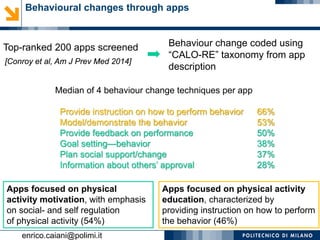
Watts et al [32] tested the effectiveness of an app delivering a cognitive behavior therapy-based program. There was a statistically significantly improvement on a depression test scale in both the app and computer intervention groups at posttest, and no difference between the 2 groups over time in follow-up. In the other RCT study of a behavioral activation app addressing mild-to-moderate and major depression conducted by Ly et al [33], it was found that the treatment worked significantly better for participants with a more severe form of depression. The research paper cited in [69] outlines the CALO-RE taxonomy of BCTs, which encompasses 40 distinct techniques aimed at guiding researchers and practitioners in identifying and categorizing BCTs for interventions to promote physical activity.
The Masterclasses feature expert-led courses on topics like happiness and creativity. When you complete a task in real life, you earn gold and experience points in the app. Articles from JMIR Formative Research are provided here courtesy of JMIR Publications Inc.
Data Collection and Analysis
Gajecki et al [28] showed that an app based on theory of planned behavior did not seem to affect alcohol consumption among university students. Lee Jordan, MS, NBC-HWC, SHRM-SCP, a certified health coach and behavior change specialist in Jacksonville Beach, Florida, and adjunct professor at Point Loma Nazarene University in San Diego, reviews research about the effectiveness of behavior change apps. Almutari and Orji (2019) only examined the 32 papers that implemented social support strategies to understand their effectiveness in encouraging physical activity using PSD.
Top 9 Mental Health Apps in 2022 Supported by Science
- For promoting physical activity in a sustained manner, these apps and corresponding research draw upon a variety of behavior change techniques and visualizations.
- Mental well-being apps were also identified as allowing users to monitor their behavior against a set goal.
- When the motivation stems from within, the likelihood of sustained effort increases exponentially.
- Subsequently, 88 duplicate studies obtained from the combination of the databases’ results were excluded using the Mendeley tool.
- Understand that setbacks are built into the process, not evidence that you’ve failed.
- A prespecified analysis plan was available for 22% (2/9) of studies in the form of a trial register [39] and study protocol [40].
This may be due to the changing environment when administering such interventions in natural settings. An effective technique to increase adherence to recommended health behaviors is through the use of self-affirmation exercises [10-12]. Self-affirmation exercises are activities in which individuals focus on and affirm personally important values. For example, a participant who highly values their family would reflect on how their lives reflect this value or specific times when this value has influenced their behavior. Self-affirmation exercises have produced positive effects in many common health goals, including reducing smoking, reducing alcohol consumption, and increasing fruit and vegetable intake [12-17].
Search
We tested the questionnaire for usability and technical issues with 5 participants. This web-based survey is in accordance with the Checklist for Reporting Results of Internet E-Surveys [24]. A web-based questionnaire comprising several sections was developed to determine the mobile app functionalities most likely to promote healthier behavior. First, participants completed questionnaires to define the user profile (Big Five Inventory-10, Hexad Scale, and perception of the social norm using dimensions of the Theory of Planned Behavior). Second, participants were asked to select the 5 functionalities they considered to be the most relevant to motivate healthier behavior and to evaluate them on a score ranging from 0 to 100. We will perform logistic regressions with the selected functionalities as dependent variables and with the 3 profile scales as predictors to allow us to understand the effect of the participants’ scores on each of the 3 profile scales on the 5 selected functionalities.
Behavioral Needs of Students: Strategies for Effective Support and Intervention
This comprehensive and detailed participant profile is crucial for the madmuscles app store reviews integrity and applicability of the research findings. After the final selection of the studies, one reviewer will assess the risk of bias of all the papers included in the final selection. A quarter of the studies will be randomly selected for validation by a second reviewer. If there is disagreement in judgment, the reviewers will discuss before consulting a third reviewer.
Table 3.
In a 2016 study, almost 60% of clinicians participating in a survey 2 years after the CBT-i Coach app was released noted that they had used the app with a client and that they felt the app improved homework adherence and treatment outcomes. It’s a free app designed to support professional insomnia or sleep disorder treatment (though it can be used on its own!). Talkspace makes therapy easy, by providing access to licensed mental health professionals right from your phone. The app gives you direct access to a therapist of your choosing, wherever and whenever you need support.
]]>