Overall, they concluded that persuasive strategies were not widely employed in mental health applications. Moreover, Wildeboer et al. (2016) examined the relationship between persuasive strategies, adherence, and the effectiveness of web-based intervention for mental health. Results indicated there is a relationship between the number of persuasive strategies and the intervention’s effectiveness.
Table 1.
This page provides a simple and visual portrayal of the user’s Big 6 health behaviors for the current day and a menu to access all other pages. When users report meeting the recommended guidelines for a particular behavior, a gold star appears next to the relevant health behavior. To promote peer-to-peer communication and education, users are prompted to select a Health4Life Buddy to help guide them through the app from the group of 6 core characters in the school-based program. On the dashboard their buddy presents different motivational celebrity quotes, tips, and prompts to log behaviors. Some research suggests that they may be a great tool to supplement traditional therapy and to help manage your wellness needs.
Stage 1: Scoping of the Literature
Apps built around external rewards work well as a starting point but tend to fade, choose something that also connects to your own values. Articles from JMIR Research Protocols are provided here courtesy of JMIR Publications Inc. This section collects any data citations, data availability statements, or supplementary materials included in this article. The data sets generated during this study are available from the corresponding author upon reasonable request.
Engagement and Adherence
This consistency suggests a steady behavior pattern, though the mode values again vary, pointing towards certain predominant behaviors on different days. HR’s data exhibit significantly higher mean and median values, around 80, suggesting more intense behavior patterns in this domain. The closeness of these measures indicates a consistent level of behavior, yet the mode suggests variations in the most common behaviors. In OS, the mean and median are remarkably stable across the week, hovering around 94–95, denoting a very consistent behavior pattern. The mode values show minor fluctuations, which might indicate specific recurring behaviors. REMS data show mean and median values in the higher teens, with slight increases on weekends.
Our picks of the best research-informed mental health apps
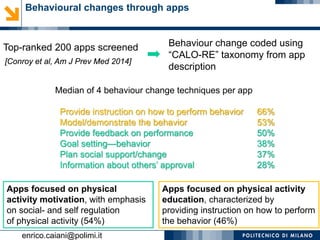
Watts et al [32] tested the effectiveness of an app delivering a cognitive behavior therapy-based program. There was a statistically significantly improvement on a depression test scale in both the app and computer intervention groups at posttest, and no difference between the 2 groups over time in follow-up. In the other RCT study of a behavioral activation app addressing mild-to-moderate and major depression conducted by Ly et al [33], it was found that the treatment worked significantly better for participants with a more severe form of depression. The research paper cited in [69] outlines the CALO-RE taxonomy of BCTs, which encompasses 40 distinct techniques aimed at guiding researchers and practitioners in identifying and categorizing BCTs for interventions to promote physical activity.
The Masterclasses feature expert-led courses on topics like happiness and creativity. When you complete a task in real life, you earn gold and experience points in the app. Articles from JMIR Formative Research are provided here courtesy of JMIR Publications Inc.
Data Collection and Analysis
Gajecki et al [28] showed that an app based on theory of planned behavior did not seem to affect alcohol consumption among university students. Lee Jordan, MS, NBC-HWC, SHRM-SCP, a certified health coach and behavior change specialist in Jacksonville Beach, Florida, and adjunct professor at Point Loma Nazarene University in San Diego, reviews research about the effectiveness of behavior change apps. Almutari and Orji (2019) only examined the 32 papers that implemented social support strategies to understand their effectiveness in encouraging physical activity using PSD.
Top 9 Mental Health Apps in 2022 Supported by Science
- For promoting physical activity in a sustained manner, these apps and corresponding research draw upon a variety of behavior change techniques and visualizations.
- Mental well-being apps were also identified as allowing users to monitor their behavior against a set goal.
- When the motivation stems from within, the likelihood of sustained effort increases exponentially.
- Subsequently, 88 duplicate studies obtained from the combination of the databases’ results were excluded using the Mendeley tool.
- Understand that setbacks are built into the process, not evidence that you’ve failed.
- A prespecified analysis plan was available for 22% (2/9) of studies in the form of a trial register [39] and study protocol [40].
This may be due to the changing environment when administering such interventions in natural settings. An effective technique to increase adherence to recommended health behaviors is through the use of self-affirmation exercises [10-12]. Self-affirmation exercises are activities in which individuals focus on and affirm personally important values. For example, a participant who highly values their family would reflect on how their lives reflect this value or specific times when this value has influenced their behavior. Self-affirmation exercises have produced positive effects in many common health goals, including reducing smoking, reducing alcohol consumption, and increasing fruit and vegetable intake [12-17].
Search
We tested the questionnaire for usability and technical issues with 5 participants. This web-based survey is in accordance with the Checklist for Reporting Results of Internet E-Surveys [24]. A web-based questionnaire comprising several sections was developed to determine the mobile app functionalities most likely to promote healthier behavior. First, participants completed questionnaires to define the user profile (Big Five Inventory-10, Hexad Scale, and perception of the social norm using dimensions of the Theory of Planned Behavior). Second, participants were asked to select the 5 functionalities they considered to be the most relevant to motivate healthier behavior and to evaluate them on a score ranging from 0 to 100. We will perform logistic regressions with the selected functionalities as dependent variables and with the 3 profile scales as predictors to allow us to understand the effect of the participants’ scores on each of the 3 profile scales on the 5 selected functionalities.
Behavioral Needs of Students: Strategies for Effective Support and Intervention
This comprehensive and detailed participant profile is crucial for the madmuscles app store reviews integrity and applicability of the research findings. After the final selection of the studies, one reviewer will assess the risk of bias of all the papers included in the final selection. A quarter of the studies will be randomly selected for validation by a second reviewer. If there is disagreement in judgment, the reviewers will discuss before consulting a third reviewer.
Table 3.
In a 2016 study, almost 60% of clinicians participating in a survey 2 years after the CBT-i Coach app was released noted that they had used the app with a client and that they felt the app improved homework adherence and treatment outcomes. It’s a free app designed to support professional insomnia or sleep disorder treatment (though it can be used on its own!). Talkspace makes therapy easy, by providing access to licensed mental health professionals right from your phone. The app gives you direct access to a therapist of your choosing, wherever and whenever you need support.